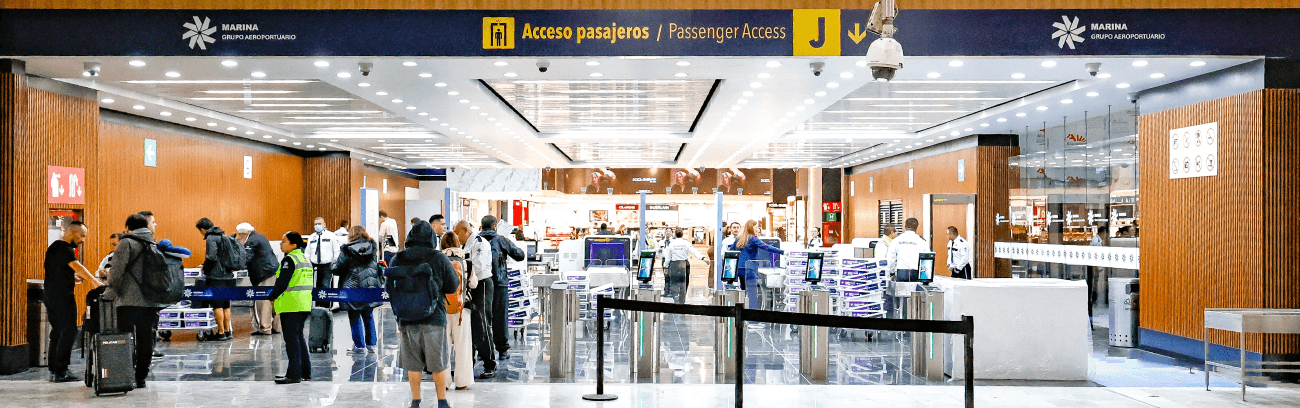
Formally inaugurated in November 1928 under the name of “Central Air Port” (Puerto Aéreo Central), the Benito Juárez International Airport of Mexico City (AICM) has evolved alongside the metropolis. Going from plains and dirt runways where biplanes landed to a colossal infrastructure that connects with more than 40 domestic and more of 55 international destinations, it is today the most important air connection hub in the country and the great gateway to the Mexican Republic. The architectural complex is strategically organized in the east of the capital, divided by its runways. Understanding its layout and the multiple ground transportation options it offers is fundamental for any visitor to achieve a safe, swift, and direct arrival to the hotel zones and tourist corridors of the city.
To travel from the airport to the main tourist spots (such as the Historic Center, Roma-Condesa, or Paseo de la Reforma), the city offers a solid Integrated Mobility Network and regulated private options:
How do I move between Terminal 1 and Terminal 2?
Due to the distance separating both complexes, it is impossible to travel between them by walking. The airport features the Aerotrén, an automated and free monorail that connects T1 with T2 in a journey of just five minutes; it operates daily from 05:00 to 23:00 hours, but strictly requires showing a digital or printed boarding pass. If you are going to pick up a relative and do not have a flight ticket, you must use the red public buses (Ground Transportation) that depart from Door 6 (T1) and Door 4 (T2), charging a minimum fare.
What is the Metrobús fare and how do I pay it?
The special fare from the airport terminals is $30.00 MXN. Cash is not accepted under any circumstances; payment is made exclusively through the Integrated Mobility Card (MI), which you can purchase and top up at the vending machines at the stop. You can also pay directly at the validator using contactless credit or debit bank cards, or digital wallets from your smartphone or smartwatch.
Is it advisable to use the Metro from the airport?
A few steps from Terminal 1 is the Terminal Aérea station of Line 5 (Yellow). Although the cost is only $5.00 MXN, it is not recommended for newly arrived tourists with heavy luggage. The cars and turnstiles lack space for bulky suitcases, the entrances involve climbing up and down heavy stairs, and the route requires multiple complex underground transfers to connect with the city’s hotel zones.
How do I identify and take a safe taxi?
The golden rule for any international traveler is to completely ignore people offering transportation services in the arrival halls. Use only the Official Taxis by purchasing your ticket at the properly marked interior counters. If you are inside the city and need to return to the airport in a street taxi, identify it by its regulatory colors (white and pink) and you must use the “Mi Taxi” module of the App CDMX to verify the driver’s license plates and monitor your trip in real-time linked to the police C5.
What should I know if I request an Uber or DiDi at the airport?
Due to federal zone regulations, the apps will indicate a specific meeting point located on the external roadways, outside the access barriers of the terminals. If you are traveling light, it is an excellent option because you know the fare in advance and pay digitally; however, if you are carrying heavy or bulky suitcases, the walk outside dodging vehicular traffic can be uncomfortable and tiring, making it much more strategic for you to hire an official taxi at the ticket counter.
 55-24-82-24-00
 https://www.aicm.com.mx/
Nearest at 0.00 kms.
Nearest at 0.00 kms.
Nearest at 0.00 kms.