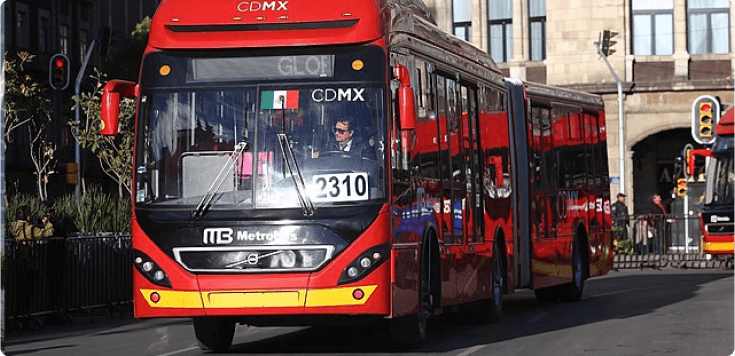
Inaugurated on June 19, 2005, on Avenida Insurgentes, the Metrobús transformed the capital’s mobility by introducing the Bus Rapid Transit (BRT) system.
Featuring exclusive lanes and stations designed for quick boarding, this surface transportation network has consolidated itself as the second most important in the city, mobilizing over a million passengers a day across its seven lines.
Traveling the metropolis in its units allows privileged visibility of the urban landscape, from its historical monuments to the most modern financial districts. The system has taken a technological leap towards sustainability, operating with a growing fleet of state-of-the-art electric buses.
To facilitate the visitor experience, the Metrobús has fully digitalized its accesses, allowing entry via the Integrated Mobility Card (MI), or even with a tap of your cell phone or bank card, eliminating barriers for international tourism.
The network extends along the city’s most strategic avenues, connecting key points for any traveler:
To guarantee world-class mobility during international sporting events, strategic improvements have been implemented in the network:
What is the fare and how do I pay for the trip? The standard cost per trip is $6.00 MXN. The only exception is the Airport service (Line 4), which has a fare of $30.00 MXN.
Access is exclusive with the Integrated Mobility Card (MI).
As a great technological innovation, you can now pay directly at the turnstiles using contactless credit or debit bank cards, as well as digital wallets (Apple Pay, Google Wallet, etc.).
Transferring between lines is free provided it is done within the connecting stations and within a limited time limit.
Where can I get the MI Card? You can purchase it for $15.00 MXN at the vending machines located at the entrance of all Metrobús stations.
These machines accept cash and bank cards for the purchase or recharging of the plastic card (with a maximum balance of $500.00 MXN).
What are the hours of operation? The system operates every day of the year:
What should I know about rush hours and the weather? The busiest hours are from 7:00 to 9:30 hrs and from 18:00 to 20:30 hrs.
During the rainy season, the speed of the buses is reduced due to safety protocols, so it is advisable to allow additional minutes for your transfers.
Is it safe to travel on the Metrobús? Yes, the stations are monitored by cameras and security personnel. It is recommended to carry your backpack in front in crowded areas and not to leave valuables in easily accessible outer pockets.
Are there exclusive zones? Yes. All buses feature a reserved section that is mandatory and exclusive for the use of women, girls and boys under 12, and people with disabilities.
There are blue seats designated strictly for preferential use by the elderly, pregnant women, and people with disabilities, while the pink seats remain exclusive to the female sector.
Un billete de metro de papel cuesta 5 pesos.
Las tarjetas de prepago (que también se pueden utilizar en el Metrobús) se pueden adquirir por 10 pesos en las taquillas de cada estación. De forma más fiable, también pueden adquirirse en las máquinas de cualquier estación de MetroBus.
Los billetes o tarjetas de Metro se presentan en los torniquetes y no son necesarios para salir del sistema, como en otras ciudades.
En la taquilla, puede comprar billetes de papel o adquirir una tarjeta de prepago, por 10 pesos. También puede cargar más dinero en una tarjeta que ya tenga.
Las máquinas de recarga de tarjetas, las mismas que venden las tarjetas en las estaciones de Metrobús, también aceptan dinero en efectivo para reponer el saldo de su tarjeta. Como en las taquillas se agotan con frecuencia las tarjetas para comprar, suele ser más cómodo adquirirlas en las máquinas de las estaciones de Metrobús.
Cada una de las doce líneas de Metro está identificada por un color y un número (1-12).
La línea 1 es rosa
La línea 2 es azul
Línea 3 es verde.
Las líneas 10 y 11 se adentran en el Estado de México (fuera de la ciudad), por lo que se identifican con las letras Línea A y Línea B.
La línea 12 es dorada.
Las direcciones están indicadas por las estaciones terminales en cada dirección.
En todas las estaciones hay mapas de los barrios y del metro. En ellos se indican los principales puntos de interés, como museos, parques y hospitales. Sin embargo, como la mayoría de las líneas de metro disponen ahora de wi-fi fiable, debería poder consultar los mapas en Internet incluso antes de llegar.
El metro funciona todos los días del año en el siguiente horario
- De lunes a viernes, de 5.00 a 24.00 h.
- Sábados, de 6.00 a 24.00 h.
- Domingos y festivos, de 7.00 a 24.00 h.
Tenga en cuenta que las horas punta de los días laborables pueden registrar importantes aglomeraciones.
- Mañanas: 7:30 - 930 AM
- Tardes: 17:30 - 20:00
Durante las horas punta, que a menudo se ven agravadas por la lluvia, más clientes utilizan el sistema y los trenes sufren más retrasos, no sólo por el tiempo, sino también por el aumento de viajeros.
Aunque la seguridad en el Metro ha seguido mejorando, le recordamos que evite:
- Llevar joyas o bolsos caros o llamativos.
- Llevar la cartera, el pasaporte u objetos de valor en los bolsillos traseros, sobre todo si hay mucha gente.
- Guardar objetos de valor en bolsillos exteriores o abiertos de la mochila o bolso.
- Las horas punta, los días laborables entre las 7:30 y las 9 de la mañana y las tardes de 5:30 a 7:30 de la tarde, dependiendo de la línea y la dirección.
- Las mujeres y los niños menores de 14 años sólo pueden utilizar los dos primeros vagones en la mayoría de los trenes.