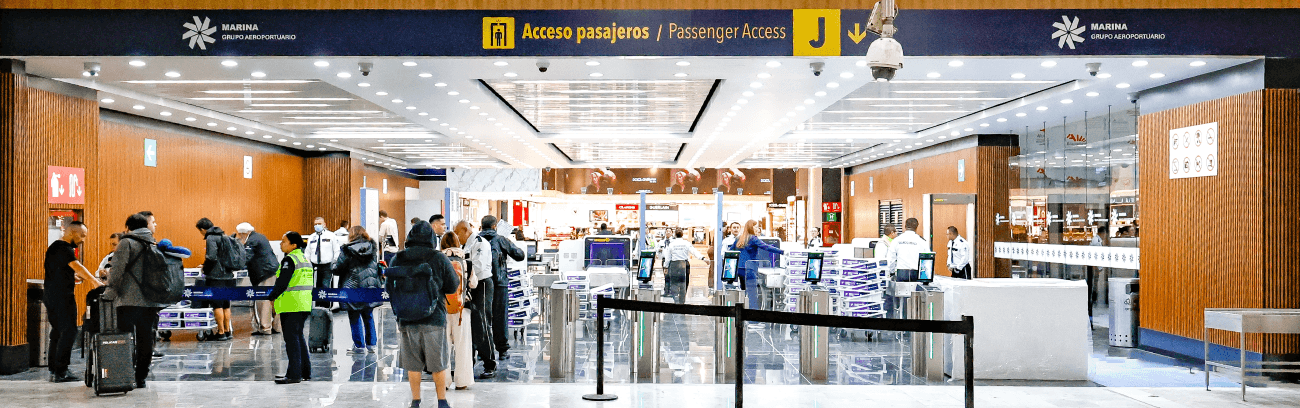
Air connectivity for Mexico City and its metropolitan area is primarily structured around two international terminals: the Mexico City International Airport (AICM) and the Felipe Ángeles International Airport (AIFA). While they transport millions of travelers, these venues also integrate cultural spaces, museums, galleries, and public artworks that offer a first glimpse into the country's history, heritage, and art.
The Mexico City International Airport (AICM), formally inaugurated in November 1928 under the name "Puerto Aéreo Central," remains the main air hub for the capital and the country. Its operations are distributed across two buildings: Terminal 1, the original and larger structure located in the Peñón de los Baños neighborhood, and Terminal 2, inaugurated in 2007 to relieve the operational saturation of the first.
Inside the AICM itself, the cultural offerings allow visitors to make the most of layovers or plan an independent visit. In the public area of Terminal 1—in Hall C of the domestic concourse, between Doors 4 and 5—is the AICM Terminal 1 Exhibition Hall, created through an initiative by the then National Institute of Fine Arts (now INBAL). Open 24 hours a day, this space presents temporary exhibitions of painting, drawing, printmaking, sculpture, photography, illustration, and artisanal expressions from different regions of Mexico.
In Terminal 2, the INAH Exhibition Hall spans 652 square meters dedicated to temporary exhibitions on the research conducted by the National Institute of Anthropology and History. Its programming brings together topics such as archaeology, history, flora, fauna, ecosystems, sustainability, the history of aviation in Mexico, art, and photographic selections from the institute's collections. This visual journey is permanently complemented by the mural Memoria y Territorio ("Memory and Territory"), unveiled on September 2, 2025, following its initial presentation at the 2025 Tianguis Turístico in Rosarito, Baja California. Created by urban artists from the capital across four large-format panels, the piece portrays symbols of the city's identity, including the canals and trajineras of Xochimilco, the Angel of Independence, the Monument to the Revolution, the Metropolitan Cathedral, the Torre Latinoamericana, the Estadio Azteca, the Cablebús, and the Iztaccíhuatl and Popocatépetl volcanoes.
To the north of the capital, about 45 kilometers from the city, the Felipe Ángeles International Airport (AIFA) expanded the Valley of Mexico's aviation infrastructure following its inauguration in 2022 on the grounds of the former Santa Lucía Military Air Base. Named in honor of General Felipe Ángeles Ramírez (1868–1919), it combines cargo operations and passenger flights with its own cultural circuit within its facilities. Among its venues, the Mammoth Museum (Museo del Mamut), dedicated to the fossil remains found in the area, the Military Aviation Museum, and a historic railway museum stand out.
To get to and from the air terminals—as well as to travel comfortably around the rest of the capital, especially when carrying luggage or traveling in the early morning hours—the city offers a combined network of public transportation and regulated private options:
Public transportation (Metrobús and Metro): Metrobús Line 4 (Airport Route) serves the AICM terminals and connects directly to the Historic Center and Bellas Artes, making it one of the most direct alternatives even when traveling with heavy luggage. Additionally, Terminal 1 can be accessed via the Terminal Aérea station on Metro Line 5 and by buses that stop near the airport.
Authorized taxi stands (Sitios): These are regulated stands located both inside and outside the airports, as well as outside hotels, shopping centers, and bus terminals. Although they charge fixed fares higher than those of street taxis, they maintain a strict registry of every driver to ensure safety and represent the most direct private option for leaving the AICM when carrying bulky luggage.
Ride-hailing apps (Uber, DiDi, Cabify, among others): They operate legally throughout the city, allow you to know the fare in advance, and facilitate direct payment with a bank card linked to the platform. They are especially practical for late-night trips or heading to areas far from public transit stations. Due to federal regulations at the AICM terminals, drivers for these apps will ask you to walk to a pickup point outside the main doors to board.
Mexico City taxis and the "Mi Taxi" module: For short urban trips outside the airport, official street taxis (white and pink) use a regulated taximeter. As a safety measure, it is recommended to download the official App CDMX and use the "Mi Taxi" module, which allows you to request a registered vehicle from your phone or enter the license plate of a taxi hailed on the street to verify the driver, share your trip in real time, and activate a panic button linked to the police.
Tipping: Leaving a tip is not mandatory for any taxi service or ride-hailing app. For street taxis and authorized taxi stands, it is not customary to add an extra amount—you only pay what is shown on the meter or the fixed fare—while on apps, it is up to the passenger's discretion to add a voluntary tip if the service was exceptional.


 Terminal 2, Eje 1 Nte. s/n, México (Lic. Benito Juárez), Venustiano Carranza, 15620 Ciudad de México, CDMX
 Airports